CAM and Mill-Turn Machining: Less Time, Better Results
What Is Mill-Turn Machining and Why Is It Becoming the Standard?
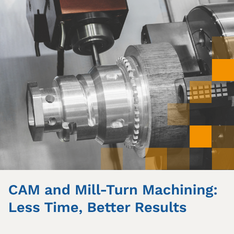
Mill turn machining is a CNC manufacturing process that combines turning and milling operations within a single machine. Designed to streamline production and reduce setup changes, mill-turn technology enables manufacturers to produce complex finished parts using a single machine tool with a dedicated configuration. A mill-turn machine combines the functionality of a CNC lathe — rotating the workpiece — with the machining capabilities of a CNC milling machine, including milling, drilling, tapping, and multi-axis operations.
This integrated approach offers several key advantages:
- less errors: Eliminating repositioning operations reduces concentricity errors and helps maintain tighter tolerances;
- reduced downtime: Fewer machine changeovers lead to less downtime and increased productivity;
- increased manufacturing capability: mill-turn machining can more effectively meet the machining needs required for complex components;
- adaptability: consolidating operations helps manufacturers meet tighter deadlines and higher quality requirements;
- controllability: Fewer manual interventions create a more efficient, predictable, and controllable production process.
As manufacturers continue to seek higher productivity and greater process reliability, mill-turn machining has become a preferred solution across a wide range of industries.
Reduced Cycle Times and Increased Productivity
One of the most significant advantages of mill-turn machining is its ability to dramatically reduce cycle times. Components that once required multiple setups and machining operations can now be completed on a single machine using a unified program and fewer manual interventions. Modern CAM software plays a critical role in maximizing these efficiency gains. By optimizing toolpaths, minimizing unnecessary machine movements, and maintaining continuous cutting engagement, manufacturers can achieve faster machining cycles while maintaining high levels of precision and surface quality. The integration of milling and turning operations within a single platform also enables advanced machining strategies that fully leverage machine capabilities. Features such as simultaneous milling on rotating workpieces and synchronized operations between the main spindle and sub-spindle allow manufacturers to further increase throughput and process efficiency. These productivity improvements translate directly into a competitive advantage. By producing more parts in less time, manufacturers can reduce unit costs, increase machine utilization, and respond more effectively to evolving market demands.Superior Part Quality Through Process Control
Another key advantage of mill-turn machining is the ability to improve machined part quality. By completing multiple operations in a single setup, manufacturers can significantly reduce the dimensional errors that often result from repeated handling, repositioning, and realignment procedures. This is especially important when manufacturing components with tight tolerances, critical functional surfaces, or complex geometries. Modern CAM software further enhances machining quality by supporting advanced roughing and finishing strategies, boring, facing operations, cutting-condition monitoring, and more, ensuring repeatability and quality consistency over time. Machine simulation is another essential element in achieving reliable and repeatable mill-turn machining. Before a program is sent to the machine, manufacturers can simulate the entire machining process to verify tool paths, detect collisions and interferences, and see potential synchronization issues. By validating the process before production begins, simulation reduces the risk of costly machine damage, minimizes unexpected downtime, and increases overall confidence in the manufacturing workflow.Managing Complexity: Tools, Axes, and Synchronization
While mill-turn machines deliver significant manufacturing advantages, they also introduce a higher level of programming complexity. Mill-turn machines can simultaneously manage multiple axes and operational units. As a result, programming does not simply take longer than on a conventional lathe, it’s also significantly more complex. Programmers must consider additional parameters like:- CNC machine kinematics;
- c-axis management for milling operations on rotating workpieces;
- y-axis utilization for eccentric machining operations;
- synchronization between spindles;
- the use of live tooling;
- part transfer (pick-off) operations.